

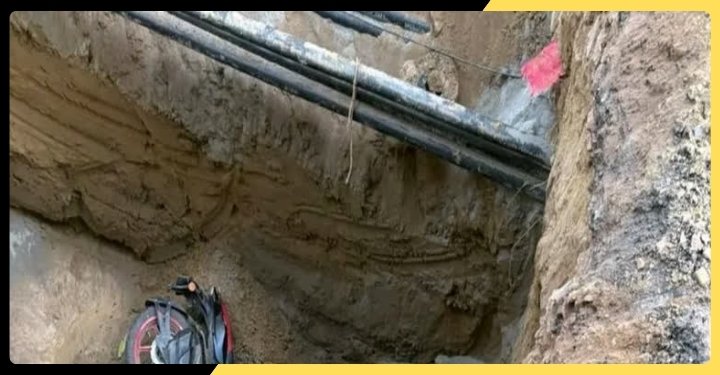
A late-night commute turned tragic in Delhi when a motorcyclist lost his life after falling into a massive, unguarded pit dug by the Delhi Jal Board (DJB) on a busy stretch of road. The incident has once again highlighted the chronic issue of unsafe road excavations in the national capital and raised serious questions about accountability, inter-departmental coordination, and public safety.
The accident occurred on Tuesday night near [area name], a locality that witnesses moderate to heavy traffic even after dark. According to eyewitnesses and police officials, the victim, a man in his early 30s, was riding his motorcycle at a normal speed when he suddenly plunged into what residents described as a “pool-sized pit” dug in the middle of the road. The pit, reportedly several feet deep and wide enough to engulf a small vehicle, had no barricades, warning signs, or reflective markers to alert motorists.
Local residents said the pit was dug by the Delhi Jal Board earlier in the week for pipeline-related work but was left unattended and exposed after work hours. “They dug it during the day and left it open by evening,” said a shopkeeper from the area. “There were no cones, no barricades, not even a piece of tape. At night, it’s impossible to see something like this.”
Emergency services were alerted immediately after passersby heard a loud crash and screams for help. Police and ambulance personnel reached the spot within minutes, but the biker had already sustained critical injuries. He was rushed to a nearby hospital, where doctors declared him dead on arrival.
The victim has been identified as [name withheld], a resident of [area], who was returning home from work. His family members, devastated by the loss, alleged gross negligence on the part of civic authorities. “This was not an accident; this was a killing caused by negligence,” said a relative. “How can anyone dig such a huge pit on a public road and leave it uncovered?”
Police officials confirmed that a case has been registered, and an investigation is underway to determine responsibility. “We are examining CCTV footage from nearby buildings and collecting statements from witnesses,” said a senior police officer. “Prima facie, there appears to be negligence in failing to secure the excavation site.”
The Delhi Jal Board, meanwhile, issued a brief statement expressing regret over the incident and stating that an internal inquiry has been ordered. “The matter is being investigated, and strict action will be taken against those found responsible,” the statement said. However, it did not clarify why standard safety protocols were not followed at the site.
Urban planning experts say this incident is symptomatic of a larger systemic failure. Delhi’s roads are frequently dug up by multiple agencies — Jal Board, PWD, MCD, gas companies, and telecom operators — often without coordination or adherence to safety norms. “There is no single authority that ensures excavations are properly marked, secured, and restored,” said a transport safety expert. “As a result, citizens pay the price with their lives.”
Residents of the area claimed this was not the first near-miss at the same spot. “Two scooters narrowly avoided falling in earlier that evening,” said a resident welfare association member. “We had complained, but no one responded.”
According to traffic police data, Delhi records dozens of accidents every year linked to poorly marked roadworks and open pits. Despite repeated directives from courts and municipal bodies mandating barricades, reflective signage, and night lighting around excavation sites, compliance remains patchy.
Following public outrage on social media, several political leaders weighed in, demanding swift action and compensation for the victim’s family. Calls for stricter penalties against erring officials and contractors have grown louder, with many arguing that fines alone are insufficient deterrents.
As dawn broke the next morning, authorities hurriedly covered the pit and installed barricades — a move many locals described as “too little, too late.” For the victim’s family, however, no corrective action can undo the loss.
The tragedy serves as a grim reminder that infrastructure work, when carried out without responsibility, can turn public roads into death traps. As Delhi continues to expand and upgrade its utilities, the question remains: how many more lives will it take before safety is treated as non-negotiable?

Leave a Reply